
Most sailing passages include some hours under engine. The wind drops under a ridge of high pressure, a foul current cuts the speed over ground, or a front is forecast to cross the route before the boat can sail clear of it. The fuel on board determines how many of these hours the boat is capable of motoring.
A fuel plan, made before departure, estimates the motoring hours, the fuel the engine burns in those hours at the rpm you plan to run, and the fuel left in the tank at the end. The fuel left over is the reserve. It covers hours that were not in the plan, such as a longer calm, a head sea, or a diversion to another port.
The short answer.
Estimate the motoring hours from the forecast along the route. Then multiply them by the fuel burn you have calculated at the rpm you intend to run, and add the engine hours for battery charging and for entering harbor. Compare the total with the usable fuel in the tank and the jerry cans. Then set a reserve and check it against the projected route for the passage.
Where the motoring hours come from.
Choose the speed over ground below which you start the engine, and set it before you estimate anything. It determines which light-wind hours count as motoring hours.
- Calms. Under a ridge or near the center of a high, the wind can be light or absent for hours. Check the forecast wind for the hours the boat is projected to be in that area. Under engine the boat crosses a calm faster than it would drift through it.
- Light wind. There is enough wind to fill the sails, but the speed over ground stays below your threshold. In a leftover swell with little wind the sails slat and the boat sails slower than its polars show, so you may choose to motor-sail through these hours.
- Foul current. A foul ocean current or tidal current lowers the speed over ground. With a breeze that moves the boat at 5 kt through the water, the speed over ground against a 2 kt current is 3 kt.
- Wind on the bow. When the course lies closer to the wind than the boat can sail, the boat tacks or motors. Motoring into the wind and a short sea increases the fuel burned per mile.
- A closing window. When a front is forecast along the route, motoring through a light patch can lead to an earlier arrival. Plan the fuel for those hours at the higher rpm you would use to arrive before the front.
When the boat motors through a calm, it reaches every later position earlier than it would by waiting for wind, so check the forecast for those earlier hours. A departure a few hours earlier or later can also move the boat into a calm or clear of one, which is why departure planning compares the motoring hours for several start times.
Fuel burn depends on rpm and load.
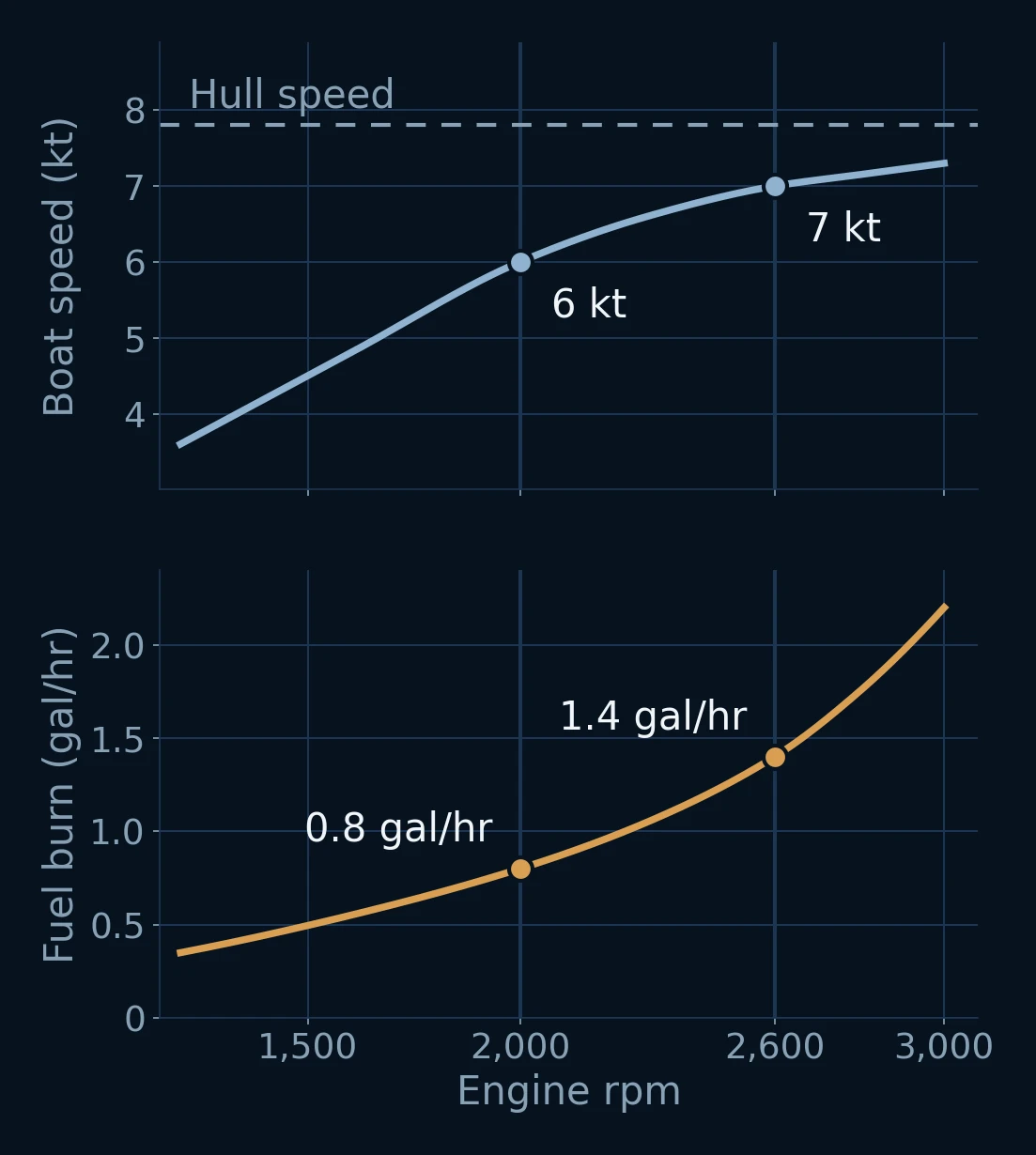
A diesel's fuel burn rises with rpm, and it rises fastest near the top of the range. In a displacement hull the last few hundred rpm add little boat speed, because the boat is already close to its hull speed, while the fuel burned per hour keeps climbing. The rpm that gives the most miles per gallon is usually well below the maximum.
Load matters as well as rpm. The governor on a diesel adds fuel to hold the rpm you set, so the same rpm burns more fuel when the engine works harder. A head sea, a headwind on the hull and the rigging, a fouled bottom or propeller, and a heavily loaded boat all add load. At a given rpm the boat's speed then falls and the burn per hour rises, and both increase the fuel used per mile.
Measure your own figures. Fill the tank, motor at a steady rpm in calm water for a measured number of hours, then refill and divide the fuel added by the hours. Repeat at two or three rpm settings and note the boat's speed at each. The engine maker's fuel curve is a starting point. It is measured on a test bench, and the propeller and hull on your boat determine the load at each rpm.
| Engine setting | Boat speed in flat water | Fuel burn per hour | Typical use |
|---|---|---|---|
| Fast idle, out of gear | None | Low, still above zero | Charging the batteries |
| Economical cruise | Well below hull speed | Moderate | Long calms, motor-sailing in light wind |
| Higher cruise | Close to hull speed | Higher, rising steeply | Arriving ahead of a front, motoring against a foul current or a head sea |
| Near maximum rpm | A little more than higher cruise | The highest | Short periods, such as clearing a harbor entrance in a sea |
Keep a reserve, and know what it is for.
The reserve is the fuel still in the tank after all the motoring hours you expect. Decide its size from the uses you can foresee on this passage.
- Rough water. A head sea can cut the boat's speed under engine sharply at the same rpm. The motion also stirs up sediment and water in a tank that is running low, and a blocked fuel filter can stop the engine.
- A diversion. Before departure, list the bail-out ports along the route. Work out the fuel needed to reach the port you would use from the furthest point on the route, under engine and into the wind if the wind is likely to be against you.
- Battery charging. The engine may run an hour or more each day to charge the batteries, and out of gear it still burns fuel. Keep fuel for extra charging hours in case the sky stays overcast.
- A longer calm. Where the models disagree on the position of a ridge, the calm can last longer than the forecast you planned on, or sit further along the route.
Plan from the usable fuel, which is less than the nominal capacity of the tank. The pickup tube sits above the bottom of the tank, and heel or motion can uncover it when the level is low. Calibrate the gauge or a dipstick against measured fills.
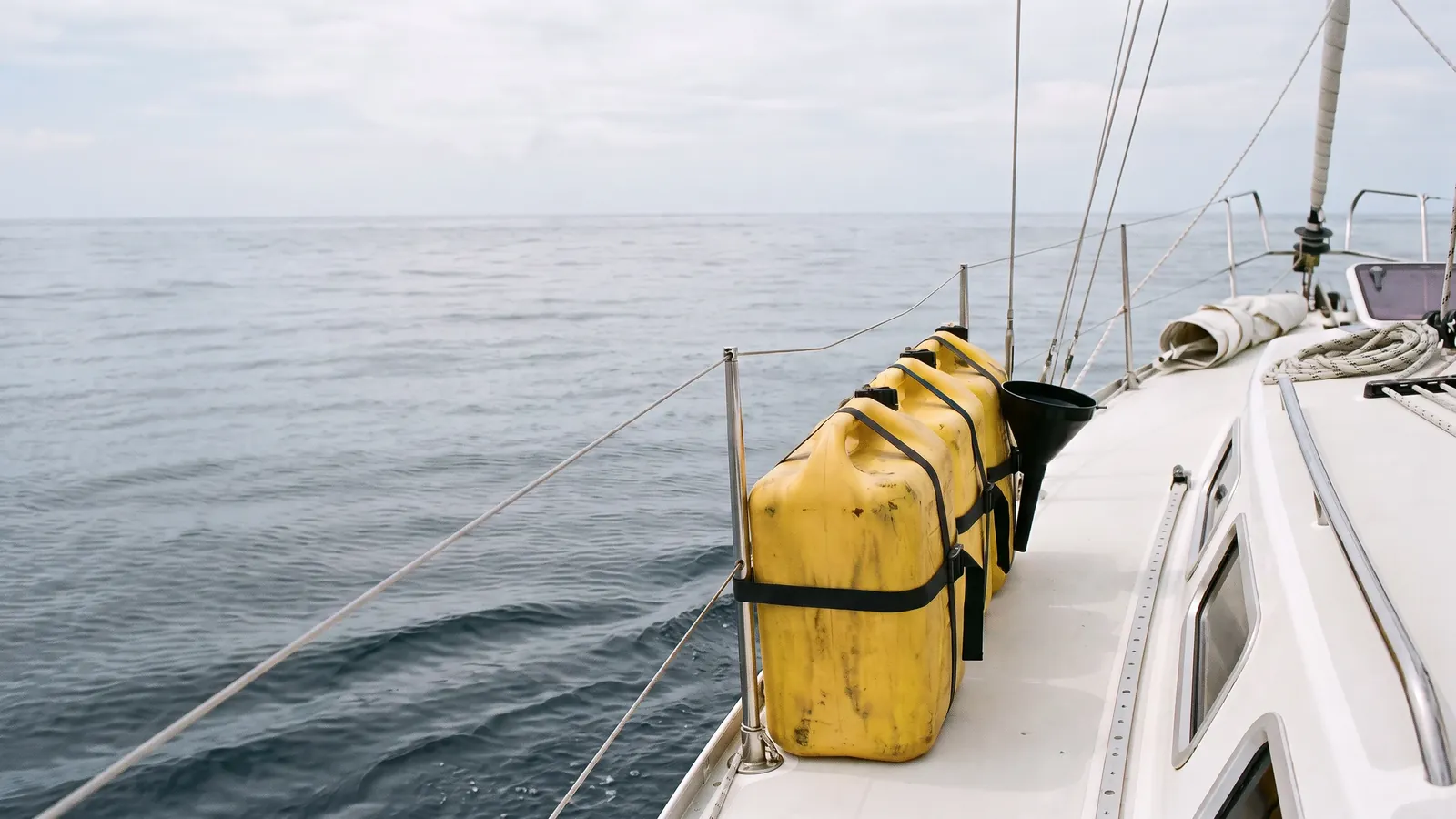
The fuel in jerry cans can be used once it is in the tank. Pouring into a deck fill in a seaway is slow and risks spilled fuel or water in the tank, so pour the cans in during a calm spell, through a funnel with a water-separating filter. Lash them where a breaking sea cannot carry them away.
A fuel plan example.
The numbers below are an illustration for one boat. Use the figures you have measured for your own engine.
The skipper of a 40 ft monohull plans a 260 nm passage of about two days. The boat's tank holds 50 gallons, of which about 45 are usable, and it carries two 5-gallon jerry cans, so 55 gallons are available. The skipper has measured 0.8 gal/hr at 2,000 rpm, which gives 6 kt in flat water, and 1.4 gal/hr at 2,600 rpm, which gives about 7 kt. Out of gear for charging, the engine burns about 0.4 gal/hr. The skipper motors when the speed over ground drops below 4 kt.
The forecast along the route shows a ridge across the middle of the passage, with 16 hours of wind too light for the boat to sail at 4 kt while it crosses the ridge. Near the end the boat reaches a point of land as the tidal current turns foul, and the skipper expects 5 hours at 2,600 rpm. The plan also allows an hour a day of charging and an hour to enter the harbor and anchor.
- Calm under the ridge. 16 hours at 0.8 gal/hr is 12.8 gallons.
- Foul current at the point. 5 hours at 1.4 gal/hr is 7.0 gallons.
- Battery charging. 2 hours at 0.4 gal/hr is 0.8 gallons.
- Harbor entry. One hour at the 2,000 rpm rate adds another 0.8 gallons.
The plan uses 21.4 gallons and leaves 33.6 of the 55. That is about 42 hours of motoring at 2,000 rpm, or about 24 at 2,600 rpm. The skipper holds back a third of the available fuel, about 18 gallons, as the reserve.
Then the skipper tests the plan. If the ridge sits further along the route and the calm lasts 12 hours longer, that adds 9.6 gallons, and 24.0 gallons remain, which is still above the reserve. A diversion to a port 30 nm upwind into a steep sea, at perhaps 4 kt under engine at 2,600 rpm, takes about 7.5 hours and 10.5 gallons. Both events together use 20.1 gallons and leave 13.5, which is below the reserve.
The plan covers either event without touching the reserve. Both events together use part of it. Before departure the skipper decides whether that is enough for this route, or whether to carry more jerry cans or plan a fuel stop.
Motoring hours and fuel in WeatherWindow.AI.
WeatherWindow.AI accounts for the projected motor-sailing hours when the speed over ground falls below the threshold, and it calculates how hard the engine works in that hour. It estimates the fuel consumed for each motoring hour by the amount the engine needs to contribute to the minimum speed. On the Skipper and Captain plans, the Passage Report shows the fuel used and the fuel remaining. This allows the skipper to judge whether the remaining fuel is sufficient to cover an unanticipated stretch of calm wind or motoring to a port further away than planned.
Fuel range questions, answered.
How do I estimate how many hours I will motor on a passage?
Choose the speed over ground at which you start the engine. Check the forecast wind and current for the hour the boat is projected to reach each position on the route, and add up the hours in which the boat would sail slower than that speed. Add hours for a foul tidal current, for wind too close to the bow to sail, and for any motoring to arrive ahead of a front. Add charging and harbor entry last.
How do I find my boat's fuel consumption?
Measure it. Fill the tank, run the engine at one rpm for a known time in flat water, refill, and divide the fuel you put in by the hours run. Do the same at a second and a third rpm and record the speed through the water each time. The engine maker's published curve gives a first estimate, and your own measurements include the load that your hull and propeller put on the engine.
How much fuel reserve should I keep on a sailing passage?
There is no single correct figure. You can hold back a fixed share of the usable fuel, such as a third, and then test that share against the events likely on the route. These include a calm that lasts longer than forecast, a head sea that slows the boat under engine, a diversion into the wind, and extra battery charging. If the reserve cannot cover the likely ones, carry more fuel or plan a fuel stop.
Should I count jerry cans in my fuel range?
Yes, if you can get the fuel into the tank when you need it. Transferring fuel in a rough sea is slow and can let water into the tank, so empty the cans into the tank in calm water or well before the tank runs low. Filter the fuel as you pour, and keep the cans lashed on deck.
Does WeatherWindow.AI estimate motoring hours and fuel?
Yes. In Boat Settings you enter the SOG threshold for motoring, the motoring speed, the fuel consumption rate, and the capacity and current contents of the fuel tank and of the jerry cans, in gallons or liters. Departure Planning shows the motoring hours for each departure on every plan, and on Skipper and Captain it also shows the fuel used. On those two plans the Passage Report also includes the total motoring hours and the fuel figures.
Related articles
References and further reading.
- Transport Canada. Maintaining a safe pleasure craft
- North Carolina Sea Grant. Save fuel and money by running your boat by the numbers
- Royal Yachting Association. Engine checks and preventing fuel contamination
- NOAA Ocean Service. What are the doldrums?
WeatherWindow.AI is a decision-support tool, not a professional weather routing service. It describes the forecast conditions on your passage and can draw weather routes, but it does not choose your route or decide whether you leave. Any route it draws is not checked against nautical charts. It does not replace official marine forecasts, a professional weather router, or your judgment as master.