
The same route can be a different passage depending on when the boat leaves. A boat that leaves 6, 12, or 24 hours later is at a different position when a front, a wind shift, or a calm arrives, so it sails in different wind and a different sea.
Departure planning is the comparison of those passages before you choose a start time. For each candidate departure, project the boat along the route and check the forecast at each position for the hour the boat is there. Then compare the departures and decide which one suits the boat and the crew.
Assess each departure as its own passage.
Choose several start times a set interval apart, for example every 6 hours. For each one, find the strongest wind and gusts, the highest waves and their period, the squall risk, the hours spent motoring, and the arrival time. Take each value from the forecast for the place where the boat will be at that hour. The forecast for your current location shows none of this, because the boat will be somewhere else when the weather changes.
Then put the departures side by side and choose which of those passages to sail.
Why the departure time changes the passage.
Weather systems keep their own timing. A front crosses the coast at a forecast hour. Squalls build over and near land with the afternoon heating. A sea breeze fills in along many coasts in the afternoon and dies away at night. A sea builds behind a passing low and takes time to ease after the wind drops. The departure time determines where the boat is when each of these happens.
A boat that leaves six hours early may round an exposed point before the wind builds. Six hours later, the same boat may reach that point just as the front arrives, in the strongest gusts and the wind shift. A day later the front may have passed, and the boat sails with the new wind forward of the beam, in the sea left over from the old wind direction.
The departure time also changes the boat's speed along the route. In lighter wind the boat sails slower or motors, which changes where it is at every later hour and when it arrives. So for each start time, project the boat from its polars, which give its speed through the water for each wind angle and wind speed, and look up the forecast for each projected position.
What to compare across departures.
Check each of these for every departure, along the entire route and at the hours the boat is there.
- Wind and gusts. Compare the average wind and the maximum gust forecast for each departure. You reef for the gusts.
- Wind angle. Note how much of each passage is upwind, on a beam reach, and downwind. The same wind strength is harder on the boat and crew forward of the beam than aft of it.
- Waves. Compare the maximum wave height, the period, and the apparent wave angle, which is the direction of the waves relative to the boat. A short-period sea on the bow is rougher than a higher, longer-period swell on the quarter. Swell and wind waves from two directions make a cross-sea that the height alone does not show.
- Motion. Motion describes how the boat moves in the sea. Two departures with the same wave height can differ in motion because the waves reach the boat at a different angle.
- Squall risk. Note whether each departure puts the boat on a stretch of the route where convection is forecast, at the hours it is forecast. A boat that sails along a coast in the afternoon can be there in the hours when squalls build.
- Motoring and fuel. Compare the motoring hours and the fuel the boat uses on each departure. A departure with a long calm burns more fuel, so check that the boat still has a reserve after it, for rough water or a diversion.
- Passage time and arrival. Compare how long each passage takes and when it arrives. A departure in light wind takes longer. Arriving at an unfamiliar harbor in daylight is a common reason to move a departure earlier or later by a few hours.
These are the six factors of a weather window assessment (wind, sea state, squall risk, window length, fuel, and model convergence), repeated for each start time. You see the window length in the passage time. When the passage from one departure takes longer than the conditions are forecast to hold, the window is too short for that start time.
Model convergence matters more for the later departures. The forecast for a departure four days out is less certain than the forecast for tomorrow, and the timing of a front can move by hours between model updates. Before choosing a later departure because its numbers look easier, check how closely the models agree on those numbers.
An example with five departures.
A 120 nm coastal passage runs north, with an exposed point about halfway and an arrival at a harbor the crew has not visited before. At the boat's speed in the forecast wind, the passage takes about 20 hours. A cold front is forecast to cross the route at about 14:00 tomorrow. Ahead of it the wind is southerly and building. In the northern hemisphere the wind veers as a cold front passes, so behind this front it moves into the west and then the northwest, forward of the beam for a boat heading north. You set the first departure at 06:00 today, with a 6-hour interval.
- 06:00 today. The boat starts in the light morning wind and motors for the first hours, then sails with the southerly on the quarter. It rounds the point well ahead of the front and arrives at about 02:00 tomorrow, in the dark, at the unfamiliar harbor.
- 12:00 today. The southerly has filled in by midday, so the boat sails from the start. It arrives at about 08:00 tomorrow, in daylight, about six hours before the front. It sails the last hours in a building southerly.
- 18:00 today. The boat reaches the last part of the route as the front arrives there. It sails through the strongest gusts, the squalls along the front, and the wind shift on the approach to the harbor.
- 00:00 tomorrow. The front crosses the route while the boat is past the point. The rest of the passage is upwind, in the wind behind the front.
- 06:00 tomorrow. The front crosses near the point. The boat sails the rest of the route upwind, in a cross-sea where the new wind waves from the northwest run across the swell left by the southerly. This passage takes the longest of the five.
Two rules of thumb apply. Cross an exposed stretch well ahead of a front, or after it has passed and the sea has eased. Arrive in daylight at a harbor the crew does not know. By those rules, the 06:00 departure today clears the point early but arrives in the dark. The 12:00 departure arrives in daylight, about six hours ahead of the front, but sails its final hours in a building southerly, with less time to spare if the front comes early. The later departures sail into the front or the sea behind it.
The six-hour margin on the 12:00 departure depends on the forecast timing of the front. If the models disagree on when the front arrives, that margin is uncertain. The two departures tomorrow are furthest out in the forecast, so their numbers are the least certain of the five. You decide whether the margin is enough for the boat and crew.
How Departure Planning shows the comparison.
In Departure Planning you set the first departure and an interval of 6, 12, or 24 hours, and WeatherWindow.AI runs five departures. For each one it projects the boat along the route from the boat's polars and the forecast wind, and reads the forecast at each projected position and hour.
The table has one row per departure. The columns are Depart, Motion, Squall, ETA, Time, Distance, Motor, Fuel used, Average wind, Max gust, Upwind, Beam reach, Downwind, and Max waves. Beside each row is a timeline ribbon. All the ribbons share one time axis, so the ribbon for a later departure starts further to the right, and a given clock hour lines up in every row. Tabs switch all the ribbons at once between SOG, TWS, AWS, AWA, Gust, Wave, Current, Squall, Sail plan, and Motoring.
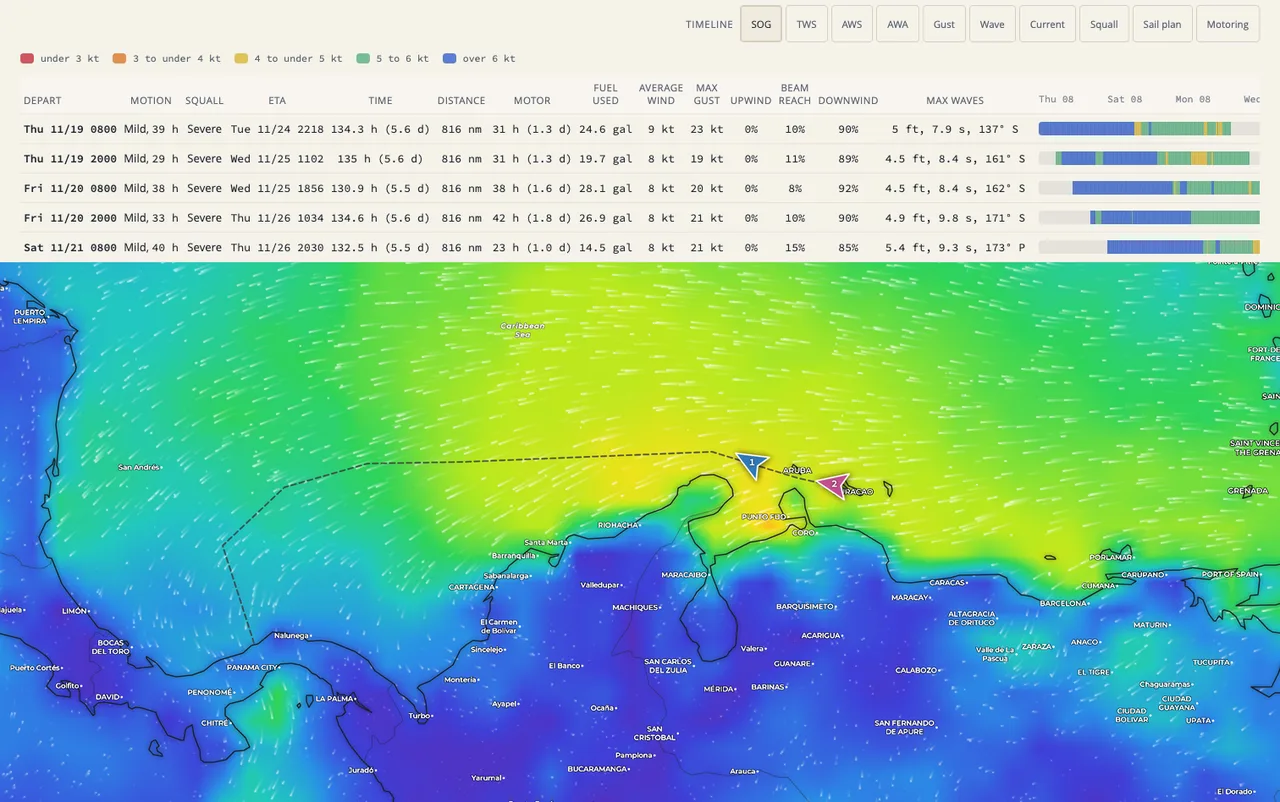
Clicking a row opens all of that departure's ribbons together, with the hour-by-hour conditions and the sail-plan table. The Departure Map shows the boat for each departure on the route.
The first departure can be up to 3 days ahead on the Sailor plan and up to 5 days ahead on the Skipper and Captain plans. Both the Squall column and the Squall ribbon need the Skipper plan or above, and the Current ribbon needs the Captain plan.
Departure Planning uses no AI and no ensemble. It shows the dead-reckoning projection and the forecast numbers for each departure.
Departure Planning and the Passage Report.
The Departure Planning table does not show how closely the models agree. A Passage Report for the start time you pick adds the model agreement and describes the conditions in plain language. AI passage assessment explains how the report is built. Both can be run again as newer forecasts arrive, since a front that moves by a few hours can change which start time you prefer.
Departure planning questions, answered.
What is departure planning for a sailing passage?
Departure planning is comparing several start times for the same route before choosing one. For each start time you work out where the boat will be, hour by hour, and check the forecast there. Weather systems move, so each start time puts the boat in different conditions.
Why does leaving a few hours later change the passage?
The boat reaches each part of the route at a different hour, and the weather there has changed by then. A later departure can put the boat at an exposed point just as a front, an afternoon of squalls, or a building sea arrives there. An earlier departure might already be past that point. The boat's speed changes with the wind at each hour, so the arrival time moves as well.
What should I compare between departure times?
Check the wind strength and the strongest gusts, the share of the passage on each point of sail, and the maximum waves with their period and direction. Add the motion, the squall risk, the motoring hours and fuel used, and the passage and arrival times. Check each one along the entire route, at the hour the boat is on each part of it, and check model convergence, especially for the later departures.
How far ahead is it useful to compare departures?
Forecasts lose certainty the further ahead they reach. Departures in the next day or two rest on the steadier part of the forecast. Departures four or five days ahead show the likely pattern, but the timing of fronts and wind shifts can still move by hours. Compare the models for those later departures and expect the numbers to change.
Does Departure Planning use AI?
No. Departure Planning uses the boat's polars to project its position for each departure and shows the forecast numbers at each projected position. It does not use AI or an ensemble. The Passage Report for the departure you choose is a separate run, which takes minutes.
Should I re-check a departure I chose days ago?
Yes. A departure chosen days ahead was based on the forecast available at the time. Each model update can change the forecast timing of a front or the wind along the route. Re-run the comparison after each model update and again on the day you leave, to see whether the departure still suits the boat.
Related articles
References and further reading.
- Royal Yachting Association. Passage planning
- Royal Yachting Association. Weather and tides
- UK Met Office. How accurate are our public forecasts?
- NOAA JetStream. The sea breeze
WeatherWindow.AI is a decision-support tool, not a professional weather routing service. It describes the forecast conditions on your passage and can draw weather routes, but it does not choose your route or decide whether you leave. Any route it draws is not checked against nautical charts. It does not replace official marine forecasts, a professional weather router, or your judgment as master.