
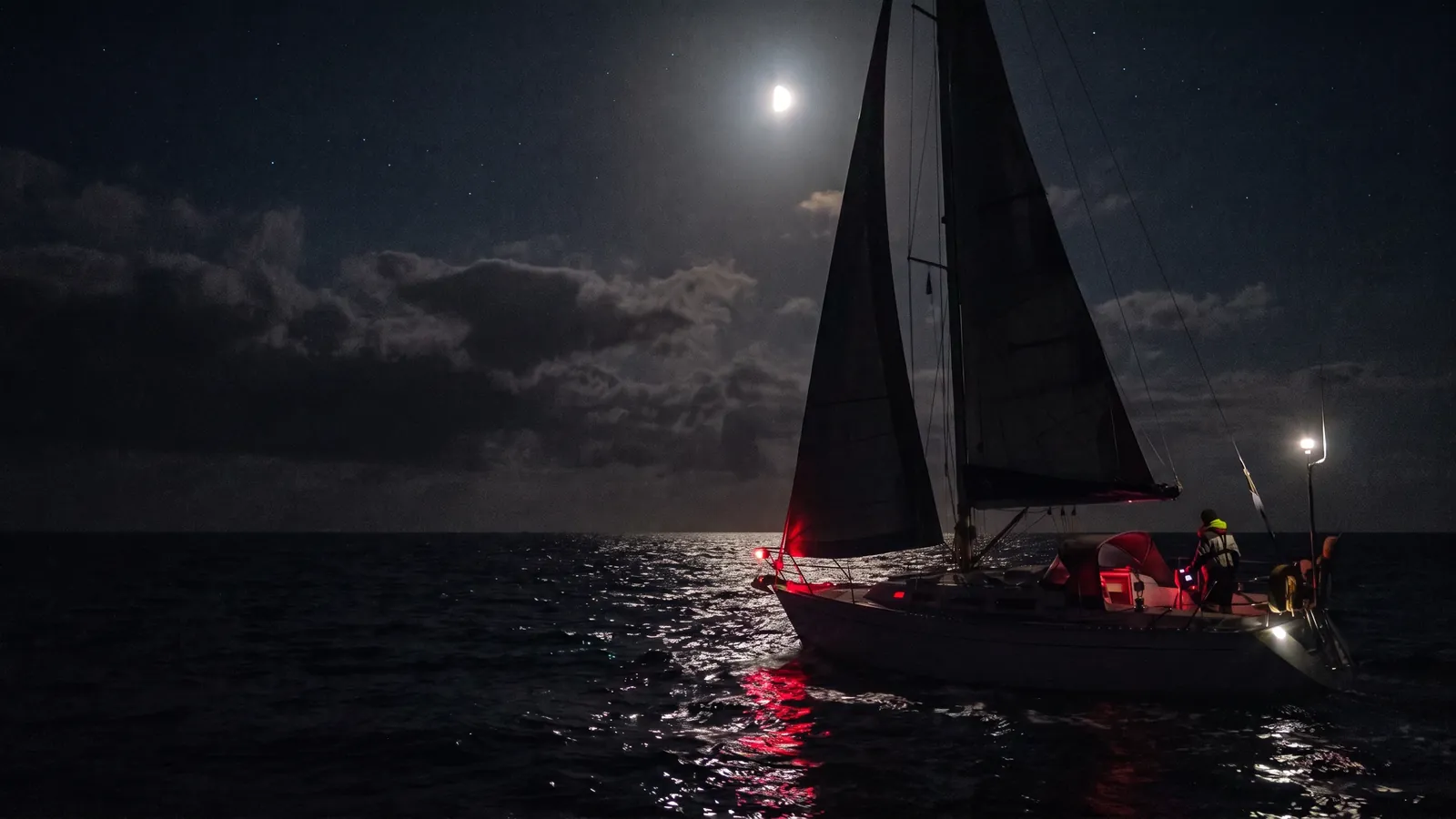
On any passage longer than a day, the boat sails through at least one night. After dark the crew cannot see the waves or the cloud, and a sail change takes longer with fewer people on deck. The usual preparation is to reef before sunset and to expect the boat to sail slower until sunrise.
Night hours also change the passage plan. A boat that sails slower at night is further back on the route at every hour after the first sunset, so it arrives later. A landfall, a pass through a reef, or a busy shipping lane is easier to handle in daylight, and the departure time determines whether the boat reaches it at noon or at 03:00.
Prepare for the night while it is light.
Do the night's work before dark. Reef for the worst of the overnight forecast, rig the jackstays, and post the watch schedule and the standing orders before the first watch at sunset. In the passage plan, use a lower boat speed for the night hours than for the day, and choose the departure time so the landfall and any hazard on the route fall in daylight. After dark, the crew finds other vessels and squalls by keeping a lookout and watching the radar.
Set the boat up before dark.
The person on watch at night may be alone in the cockpit, so set the boat up for the entire night while the crew can still see the deck.
- Reef at dusk. Reef for the strongest gusts forecast before sunrise. A reef put in at 17:00 with the crew awake is easier than a reef at 02:00 with one person on deck by headlamp.
- Take down the specialty sails. A spinnaker, gennaker, or code zero is hard to bring down in the dark when the wind rises. Take them down before sunset and sail the night under the main and the jib.
- Jackstays and tethers. Run jackstays from the bow to the stern along both side decks, in flat webbing that does not roll underfoot. Fit a strong point in the cockpit that the crew can reach from the companionway, so nobody steps on deck unclipped. Make it a rule that everyone on deck at night wears a lifejacket with a harness and a light, and is clipped in.
- Navigation lights and tools. Switch on the navigation lights at sunset and check each one. Keep a red headlamp, the hand-bearing compass, and the binoculars within reach of the helm. Red light preserves night vision.
Keep a watch and a lookout.
A watch system is the schedule of who is on deck and who sleeps. With two crew, stand three hours on and three off, or four on and four off. With three crew on 4-hour watches, each person keeps the same hours every night. With 3-hour watches there are eight in 24 hours, and eight does not divide by three, so the schedule shifts each day and the 03:00 watch passes from one person to the next.
Write standing orders for the night and keep them at the chart table. They list when the person on watch wakes the skipper, for example when the wind rises past an agreed speed, when another vessel's bearing holds steady as it closes, when a light cannot be identified, or whenever the person on watch is unsure.
Look around the entire horizon at short intervals, including astern and under the headsail on the lee side. A ship at 20 kt covers 10 nm in 30 minutes, so a light near the horizon at one look can be close at the next. The radar shows vessels and rain at their range and bearing. AIS shows the vessels that transmit it, with their course, speed, and closest point of approach. Some small craft and fishing vessels do not transmit AIS.
Squall clouds are hard to see at night, and over warm water convection can build after dark. The signs are stars disappearing behind cloud, lightning, and a sudden cool gust ahead of the rain. On the radar the rain shows as a return that moves from sweep to sweep. When the forecast shows squall risk over the night hours, put the reef in for the squalls at dusk and keep a closer radar watch through the night.
Identify other vessels by their lights.
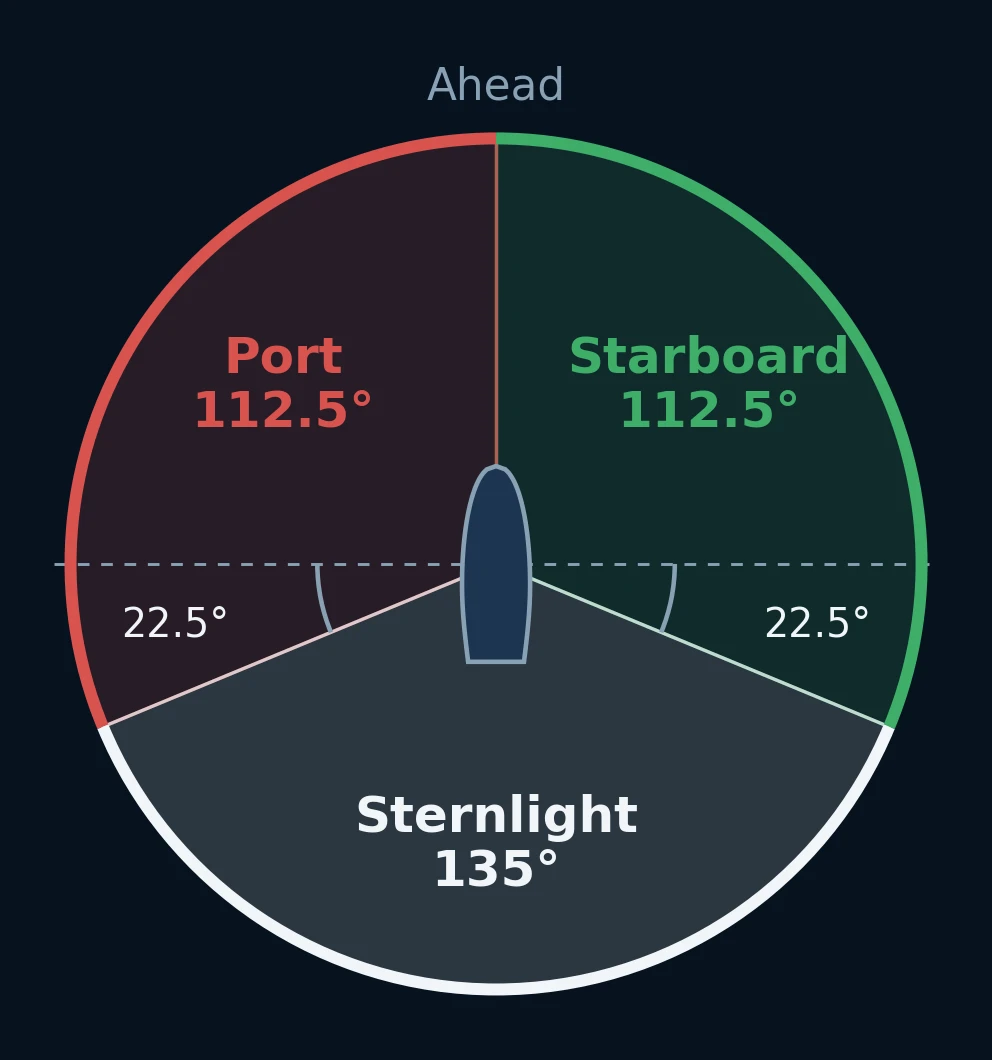
At night the crew sees another vessel only by its lights. The International Regulations for Preventing Collisions at Sea (COLREGs) specify the color and the arc of each light, so the lights show the type of vessel and the way it is heading. The table shows the light patterns you will see most often offshore.
| What you see | What it is |
|---|---|
| Red and green together, below a white light | A power-driven vessel heading toward you. |
| Green only, under a white light | You see the starboard side of a power-driven vessel. |
| Red only, with a white light above it | A power-driven vessel with its port side toward you. |
| Two white masthead lights, the aft one higher | Usually a power-driven vessel of 50 m or more. When the two lights line up vertically, it is heading straight at you. |
| Red, green, or both, with no white light above | A sailing vessel under sail. Under 20 m it may show one tricolor light at the masthead in place of these. |
| A single white light | The sternlight of a vessel moving away from you, a vessel under 50 m at anchor, or a small craft. |
| Green over white, all-round | A vessel trawling. |
| Red over white, all-round | A fishing vessel using a method other than trawling. |
Take a bearing on any light that is closing, with the hand-bearing compass or the electronic bearing line on the radar. If the bearing does not change while the distance closes, there is a risk of collision. Under sail your own boat shows its sidelights and sternlight, or the tricolor. With the engine running it is a power-driven vessel, so the tricolor goes off and the masthead light (the steaming light), the sidelights, and the sternlight go on.
Planning a daylight arrival.
A boat usually sails slower at night. It is reefed for the strongest wind of the night, and one person on watch trims less often than a full crew does in daylight. Start from the boat's speed in the forecast wind at each hour, taken from its polar diagram for the true wind speed and angle. Then reduce it for the hours between sunset and sunrise, by an amount you know from your own passages. On a long passage east or west, sunset by UTC comes about 4 minutes earlier for each degree of longitude the boat sails east, so look up sunrise and sunset for the position the boat will have reached.
Next, plan to pass the hazards in daylight. A landfall at an unfamiliar harbor, a reef pass that needs the sun high to show the coral, and a shipping lane are all easier when the crew can see. To find the departure time, work back from the arrival time you want, with the night hours at the slower speed. Departure planning across several start times shows which one puts the landfall in daylight. If the boat still reaches the coast before dawn, heave to or sail slowly offshore with sea room until there is light to enter.
An example with two nights at sea.
A crew of three plans a 240 nm passage to an island whose harbor is entered through a pass in the reef. They want to reach the pass at about 09:00, when the sun is high enough to show the coral heads. The passage is in the tropics near the equinox, so sunrise is about 06:00 and sunset about 18:00 along the route. To keep the arithmetic simple, assume the boat sails 6 kt in the forecast wind throughout, and the crew plans the night hours at 85% of that, about 5.1 kt. The numbers are illustrative. A shipping lane crosses the route 130 nm from the start.
Working back from 09:00 on the third day gives a departure at 13:30 on the first day.
- Day 1, 13:30 to 18:00. 4.5 hours at 6 kt, 27 nm. The crew reefs at 17:00 and starts 3-hour watches at 18:00.
- Night 1, 18:00 to 06:00. 12 hours at 5.1 kt, 61 nm, and 88 nm sailed. One person is on deck at a time.
- Day 2, 06:00 to 18:00. 12 hours at 6 kt, 72 nm, and 160 nm sailed. The crew shakes out the reef after sunrise, and the boat crosses the shipping lane at about 13:00.
- Night 2, 18:00 to 06:00. 61 nm, and 221 nm sailed. The forecast shows squall risk after midnight, so the crew puts in two reefs at dusk and keeps the radar on all night.
- Day 3, 06:00 to 09:00. The last 19 nm at 6 kt. The boat arrives off the reef a little after 09:00.
Planned at 6 kt the entire way, the same departure takes 40 hours and reaches the pass at about 05:30, before sunrise. With the slower night hours, the boat arrives about three and a half hours later. If the boat sails the nights faster than planned, it arrives early and waits offshore for daylight.
Night speed in WeatherWindow.AI.
WeatherWindow.AI slows the projected boat at night by the Night Speed Factor, under Night Sailing Performance in Boat Settings, so the projected landfall time allows for the slower night hours. It is the share of the boat's polar speed that it sails between sunset and sunrise, from 50% to 100%, with 85% as the default and 100% turning it off. Sunset and sunrise are worked out at the boat's projected position at every hour, and the motor-sailing speed stays the same. The right figure for the factor comes from comparing the boat's night and day speeds on earlier passages.
Night sailing questions, answered.
How do you prepare a sailboat for a night at sea?
Reef before sunset for the highest gusts in the overnight forecast, and take down any spinnaker, gennaker, or code zero. Rig jackstays along both side decks and check that each lifejacket has a harness, a tether, and a light. Test the navigation lights. Before dark, agree on who stands each watch and when to wake the skipper.
What watch system suits a small crew at night?
For two people, the common schedules are 3 hours on and 3 off or 4 on and 4 off. With three crew, each person is on watch for one period in three. Eight 3-hour watches fit in a day, and eight is not a multiple of three, so the hours rotate and nobody stands the 03:00 watch every night.
How do you tell which way a ship is heading at night?
Look at its lights. A white masthead light above both a red and a green sidelight means a power-driven vessel coming toward you. Green alone shows its starboard side, and red alone its port side. On a ship of 50 m or more, two white masthead lights in a vertical line mean it is heading at you. Take bearings over several minutes. A steady bearing while the range closes means a risk of collision.
Should you make landfall at night?
Where you can, plan to arrive in daylight, especially on a first visit to a harbor or at a pass through a reef. At night the lights ashore make the navigation lights hard to pick out, and rocks, coral, and unlit moorings do not show. If the boat arrives early, stay out with sea room, hove to or sailing slowly, until it is light.
Do sailboats sail slower at night?
Usually, yes. A boat reefed down for the night, with one person on deck trimming the sails less often, sails slower than it does in daylight. A plan that uses daytime speeds through the night puts the boat too far along the route for each hour after dark, so the planned arrival is too early. Plan the night hours at a reduced speed, based on the boat's own passages.
Does WeatherWindow.AI allow for night sailing?
Yes, when it projects the boat along the route. The Night Speed Factor in Boat Settings reduces the boat's sailing speed from sunset to sunrise, 85% by default, and works out sunset and sunrise each hour at the projected position. Motor-sailing speed is not reduced. Each specialty sail also has an "Allow use at Night?" setting, and a sail set to No is not used in the night hours.
Related articles
References and further reading.
- US Coast Guard Navigation Center. Part C, lights and shapes, Rules 20 to 31
- NOAA and US Coast Guard. International and U.S. inland navigation rules
- Royal Yachting Association. Safety lines, clipping on
- US Sailing. Safety at sea studies, safety tips
WeatherWindow.AI is a decision-support tool, not a professional weather routing service. It describes the forecast conditions on your passage and can draw weather routes, but it does not choose your route or decide whether you leave. Any route it draws is not checked against nautical charts. It does not replace official marine forecasts, a professional weather router, or your judgment as master.