
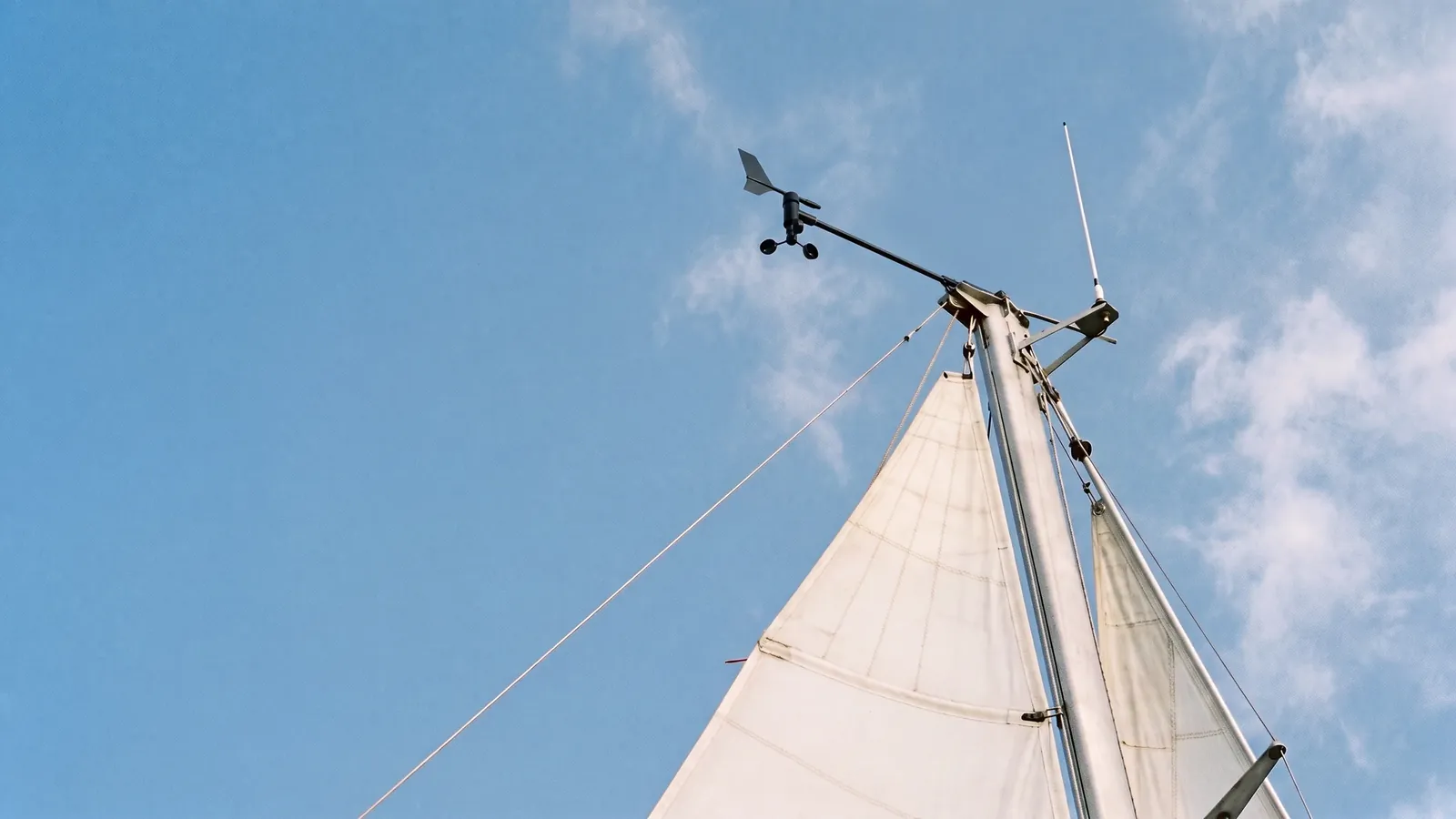
True wind is the wind as it blows over the sea, the wind a forecast gives and a boat at anchor feels. Apparent wind is the wind across a moving boat. It combines the true wind with the headwind created by the boat's own motion. The sails work in the apparent wind, and the masthead anemometer measures it.
On the same day the two can differ by several knots and by many degrees. Sailing upwind, the apparent wind is stronger than the true wind. Sailing downwind, it is lighter. A forecast is given in true wind and the crew reefs to the apparent wind, so to plan a passage from a forecast you work out the apparent wind on each leg.
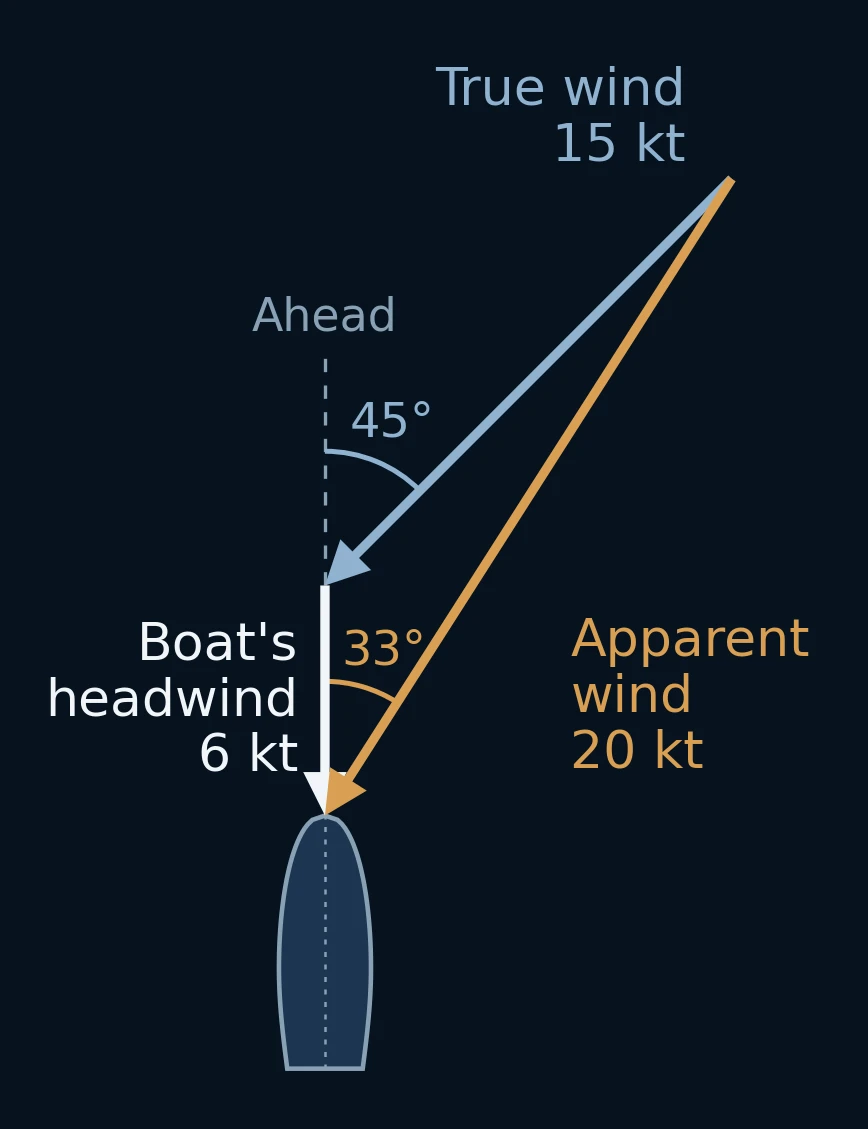
Apparent wind combines two winds.
A boat motoring at 6 kt on a calm day feels a 6 kt breeze from dead ahead. When a true wind blows as well, the wind on deck is the combination of that headwind and the true wind. The two add as vectors, in the same way a current combines with the boat's course and speed through the water. The result is the apparent wind speed (AWS) and the apparent wind angle (AWA), measured from the bow. The true wind has a speed and an angle of its own, the true wind speed (TWS) and the true wind angle (TWA).
The result changes with the point of sail.
- Upwind and on a beam reach. With the true wind forward of the beam or on it, the boat's headwind adds to the true wind, and the wind on deck is stronger.
- Well aft of the beam. With the true wind on the quarter or astern, the boat moves away from it, and the apparent wind is lighter than the true wind. The changeover happens a little aft of the beam, at an angle that depends on the boat's speed relative to the true wind speed.
- On every heading. While the boat is moving, the apparent wind angle is smaller than the true wind angle, so the apparent wind is always further forward. The faster the boat sails, the further forward the apparent wind moves.
How much the wind changes on each point of sail.
The table shows a boat sailing at 6 kt with 15 kt of true wind, on three headings. The values are approximate. They assume flat water and no current, and the same boat speed on each heading to keep the comparison simple. A real boat sails at a different speed on each point of sail, and its polar diagram gives that speed for each true wind speed and true wind angle.
| True wind angle | Point of sail | Apparent wind speed | Apparent wind angle |
|---|---|---|---|
| 45° | Close-hauled | About 20 kt | About 33° |
| 90° | Beam reach | About 16 kt | About 68° |
| 150° | Broad reach | About 10 kt | About 133° |
The true wind is 15 kt in every row. From the close-hauled heading to the broad reach, the wind on deck falls by about half. To work out other cases, use AWS = √(TWS² + BS² + 2 × TWS × BS × cos TWA), where BS is the boat's speed.
Why the forecast and the instruments differ.
The forecast and the boat's instruments describe the wind in different terms. Allow for these differences when you compare the two.
- The forecast gives true wind. A weather model gives the wind relative to the earth's surface, usually at a standard height of 10 m above the sea. It does not depend on any boat's course or speed. The guide to reading marine forecasts covers the forecast products.
- The anemometer measures apparent wind. The masthead unit measures the wind across the moving boat. The true wind on the instrument display is calculated from the apparent wind and the boat's own speed and heading, so an error in the log or the compass shows up in the true wind figure.
- The masthead is higher than 10 m on many boats. Wind generally increases with height above the sea, because the surface slows the air closest to it. An anemometer well above 10 m often reads higher than the 10 m winds reported by the forecast, due to the height of the mast.
- Current changes the wind over the water. The forecast wind is relative to the ground, and most instruments compute the true wind from the boat's speed through the water. A 2 kt current running against a 15 kt wind gives about 17 kt of wind over the water for a boat drifting with the current. A current running with the wind reduces the wind over the water by the same amount.
Reef to the apparent wind.
The load on the sails and the rigging comes from the wind across the boat, so a reefing plan is written in apparent wind speed. The wind speed for each reef often changes with the apparent wind angle as well, because the heeling force on the sails is greater with the wind forward of the beam.
Downwind, the apparent wind can stay below the first reef in a true wind that would need a reef or more close-hauled. The crew carries full sail on a long run, and the wind on deck does not show how strong the true wind has become. When the boat has to come up onto a reach or close-hauled, to round a point of land or to keep clear of other ships, the apparent wind can double, and there is too much sail up for the new heading. Reefing for a squall offshore on a downwind leg has the same difficulty, because the mainsail is usually reefed with the boat brought up toward the wind, where the apparent wind is strongest.
An example on two headings.
A coastal passage runs 30 nm on a broad reach to a point of land, then 25 nm close-hauled to the harbor. The forecast gives 15 kt of true wind from the same direction for the entire day. For simplicity the boat sails at about 6 kt on both legs, in flat water with no current. The crew's reefing plan puts the first reef in at 20 kt apparent. All of the figures are approximate and for illustration only.
- The first leg. The true wind is at 150°. The apparent wind is about 10 kt at about 133°, well inside the full-sail range of the reefing plan.
- After the point. The true wind is the same 15 kt, now at 45°. The apparent wind is about 20 kt at about 33°, which is the first reef in the crew's plan. The wind on deck has doubled with no change in the forecast.
- If the true wind rises to 25 kt. On the first leg at 6 kt, the apparent wind reaches only about 20 kt, the first reef. In practice the boat sails faster in 25 kt, which keeps the apparent wind even lower. If the crew reefs by the apparent wind alone, the boat reaches the point with too much sail up, and on the close-hauled heading the apparent wind is about 30 kt.
Plan the reef for the point from the true wind and the close-hauled angle, and put it in before the turn.
Apparent wind in the Passage Report.
Forecast models give the true wind 10 m (about 33 ft) above the sea. WeatherWindow.AI scales that wind up to the height of your masthead, from the air draft in Boat Settings, and combines it with the boat's projected heading and speed to give the apparent wind speed and angle your anemometer would show at each hour. The report's peak wind is the highest apparent wind of the passage, shown beside the true wind at that hour. Because your reefing plan uses apparent wind, the sail plan for every hour is clear before departure.
True and apparent wind questions, answered.
What is the difference between true wind and apparent wind?
The wind over the sea, with no boat moving through it, is the true wind. It has a speed and a direction. Apparent wind is what a moving boat feels. It adds the boat's own headwind to the true wind. The sails and the masthead anemometer both experience the apparent wind, and a forecast gives the true wind.
Why is apparent wind stronger when sailing upwind?
Sailing toward the wind, the boat's own headwind and the true wind add together. Close-hauled at 6 kt with a true wind of 15 kt, a boat has roughly 20 kt across the deck. The apparent wind angle is also further forward, about 33° from the bow in that example, where the true wind angle is 45°.
Why does the wind feel lighter when sailing downwind?
With the true wind well aft, the boat sails away from it, and its own motion reduces the wind on deck. In 15 kt of true wind at 150°, a boat at 6 kt has about 10 kt of apparent wind. On a long run the crew can underestimate how much the true wind has built, and notice it only when the boat comes up toward the wind.
Does a marine forecast give true wind or apparent wind?
A marine forecast gives true wind. It describes the wind over the ground, normally for the wind 10 m above the sea surface, and it is the same whatever course the boat sails. To find the wind on deck for a leg, combine the forecast wind with the boat's heading and speed on that leg. If your anemometer is higher than 10 m, the wind at the masthead is often stronger than the forecast.
Should I reef by true wind or apparent wind?
The sails and the rigging carry the load of the apparent wind, so the wind speeds in a reefing plan are apparent wind speeds. On a downwind leg the true wind can rise well past the first reef in the plan while the wind on deck stays under it. When a course change will move the apparent wind forward, calculate the apparent wind for the new course first, and reef before the turn if it is above the figure in your reefing plan for the sail you have up.
How does current affect true and apparent wind?
A current carries the water and the boat over the ground, and the air keeps its own speed over the ground. Wind blowing against the current is stronger over the water than the forecast wind, and wind blowing with the current is lighter. Instruments that use the log speed to calculate true wind show the wind over the water, so in a current their true wind figure can differ from the forecast.
Related articles
References and further reading.
- Joe Wolfe, UNSW Physics. The physics of sailing
- US Sailing. Start windsurfing right, understanding wind
- John D. Norton, University of Pittsburgh. Paradoxes of sailing
- Smith, Bourassa and Sharp, Florida State University. Establishing more truth in true winds
WeatherWindow.AI is a decision-support tool, not a professional weather routing service. It describes the forecast conditions on your passage and can draw weather routes, but it does not choose your route or decide whether you leave. Any route it draws is not checked against nautical charts. It does not replace official marine forecasts, a professional weather router, or your judgment as master.