
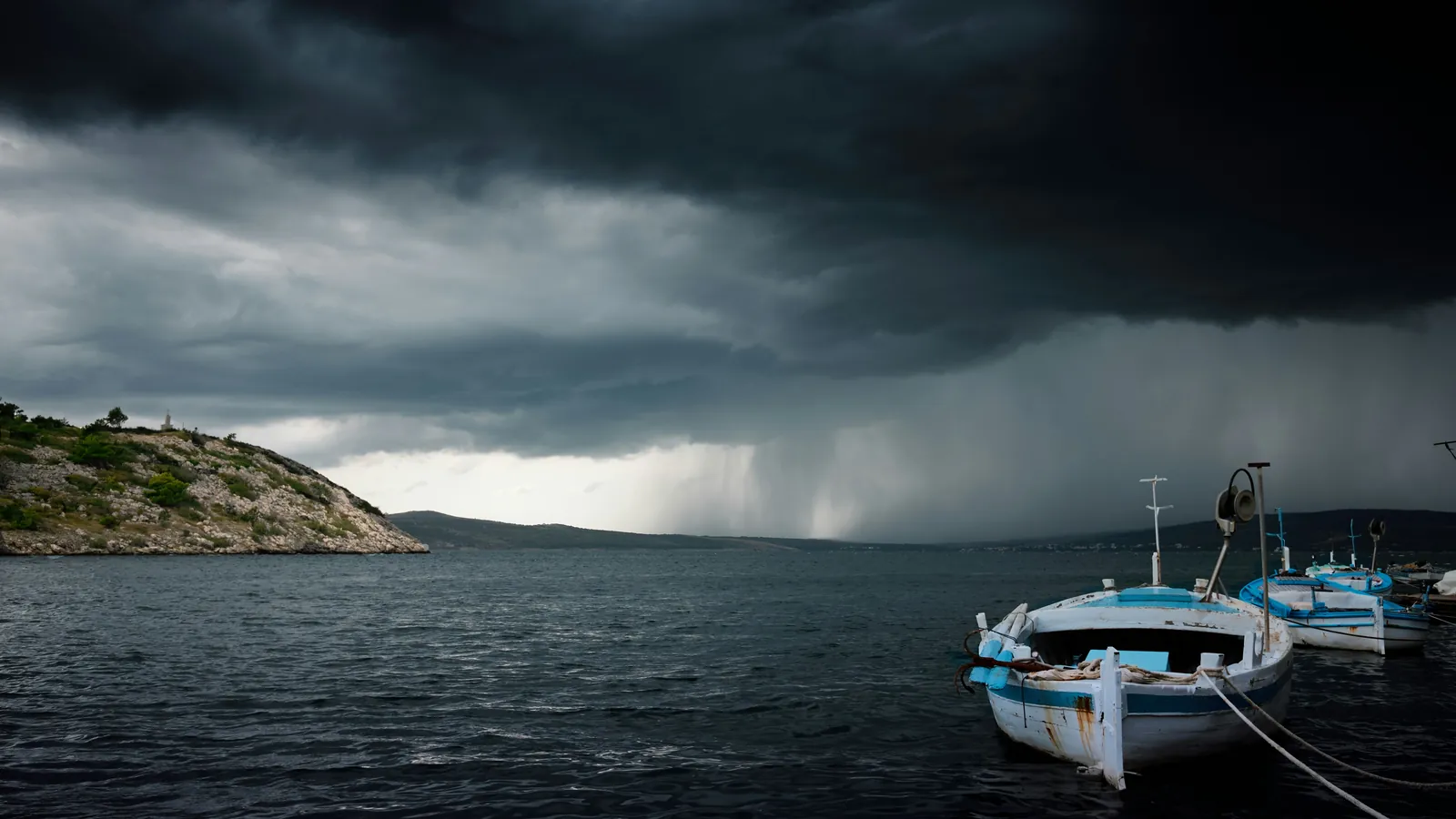
How to make a GO / NO-GO passage decision
A GO / NO-GO decision is the single call every passage comes down to: leave now, wait for a better window, or change the plan. Getting it right is less about confidence than about a clear, repeatable way to assess the weather.
The decision turns on a set of factors (wind, sea state, squall risk, window length, fuel, and forecast confidence) evaluated along the whole route, over time. This page lays out the five-level scale, the questions behind every call, and the mistakes that sink an otherwise good decision.
Five calls, not a yes/no.
"GO or NO-GO" is a useful headline, but real passages live someplace in between. A five-level scale captures the range between a clean departure and a hard stop, and gives you an underway call for when conditions change after you leave.
- ◆ GO
- Conditions stay inside your boat's and crew's limits along the entire route, for longer than the passage. Depart as planned.
- ▲ CAUTION
- Generally workable, but with factors that need monitoring: a building breeze, an escalating sea-state, or a building front near the route. Go with a plan to monitor it.
- ▲ MARGINAL
- Right at the edge of your limits. Defensible only with an experienced crew, solid bail-out options, and a real willingness to turn around.
- ■ NO-GO
- One or more factors exceed safe limits somewhere along the route. Wait for the next window. The sea will still be there tomorrow.
- ■ DIVERT
- Conditions ahead have severely deteriorated past the vessel's and crew's limits. Change destination, alter course, or seek shelter.
Six questions behind every call.
Work through these in order, assessed along the entire route. If any one of them is a clear no, the passage is a NO-GO, regardless of how good the others look.
- Is the wind workable for the entire route? Inside your boat's range and off the bow, not just at your berth. Read the gust forecast, not only the average; gusts routinely run well above the mean.
- Is the sea state comfortable? Period and direction matter just as much as height. A long-period swell on the beam is workable; a short-period or confused cross-sea at the same height is punishing.
- Is squall and convective risk low? Along the route, not just at the start. A line of squalls can turn a benign forecast into a rough, even dangerous, day.
- Does the window outlast the passage? You want settled conditions the day before you depart, throughout the passage itself, and a spare day after your planned arrival in case the next system arrives early or you sail slower than planned.
- Do the models agree? Forecast convergence is a decision input that should not be ignored. When forecasts diverge, the window is not clear, so widen your margins or wait for the next update.
- Do you have the fuel for the plan? Light air, foul current, or a shrinking window can turn a planned sail into prolonged motoring. Confirm you carry enough fuel, with reserve, to push through calm winds, adhere to your schedule, or reach shelter if the wind doesn't cooperate.
Decide your limits before you read the forecast.
The strongest defense against a bad call is to set your limits before you look at the weather. Write down the most wind you will take, the sea state you will accept (in terms of period and direction, not only height), and the shortest window you will leave on. Choose those numbers when no particular passage is on the line, so the forecast is measured against your limits instead of your limits being bent to fit the forecast. A limit on wave height alone is not enough, because wave period and apparent direction are equally important in deciding how comfortable or uncomfortable a passage will be.
Keep the weather call separate from your calendar. The day you hoped to leave is not an input to whether the passage is safe, and treating it as one is how sailors can quickly get themselves in trouble. These limits are the backbone of the full weather window assessment routine, which uses the same factors hour by hour along the route.
Five mistakes that sink a good decision.
Most bad passages don't come from bad luck. They come from a handful of predictable errors in how the decision was made.
- Deciding on departure-point weather: The forecast at your berth says nothing about what your boat will encounter 60 miles out, twelve hours from now. A passage is a moving target, not a single point in time.
- Get-there-itis: Anchoring to a planned date (a flight, a guest, a schedule) pressures a NO-GO into a GO. One of the most dangerous inputs to a passage decision is a deadline.
- Reading height without period: Two forecasts with the same wave height can be completely different passages. 10 foot seas can be a comfortable swell at a period of 18 seconds or a punishing, boat-breaking square sea at a period of 8 seconds.
- Trusting a single model: One model is one opinion. Without cross-checking, you can't tell whether multiple weather models converge on the same outcome.
- No abort rule: If you haven't decided in advance what conditions will cause you to divert, you'll decide in the moment, tired, committed, and biased toward pressing on.
One clear call for every departure.
WeatherWindow.AI runs these six questions for you at every point along the route. It uses a 7-model wind and 4-model wave forecast to project your position hour-by-hour. It assesses the wind, sea state, squall risk, and fuel margins, and weighs them together with AI-read synoptic charts to create an assessment of your passage. The result is a single five-level recommendation with its reasoning, GO, CAUTION, MARGINAL, NO-GO, or DIVERT. You see the source data on every assessment, and you make the final decision.
GO / NO-GO questions, answered.
What is a GO / NO-GO decision in sailing?
It's the single call every passage comes down to: depart now, wait for a better window, or change the plan. A good GO/NO-GO decision weighs wind, sea state, squall risk, window length, and forecast confidence along the whole route over time, not just the weather at your berth.
What is the difference between NO-GO and DIVERT?
NO-GO is a pre-departure call: the conditions exceed your limits, so you don't leave. DIVERT is an underway call: you've already departed your berth, but the conditions ahead have deteriorated past the thresholds, so you change destination, alter course, or seek shelter.
What does a MARGINAL passage call mean?
MARGINAL means the conditions sit right at the edge of your boat's and crew's limits. It's defensible only with an experienced crew, with good bail-out options along the route, and a genuine willingness to divert if conditions get too bad.
How do you avoid schedule pressure in a passage decision?
Separate the weather call from the calendar. Set objective limits for wind, seas, and window length before you look at the forecast, and treat the date as flexible. The phrase experienced sailors repeat is simple: Mother Nature doesn't care what day it is.
Should beginners use stricter limits?
Yes. Limits are personal. They depend on the boat, the crew's experience, and tolerance for discomfort. A new crew should set conservative thresholds and widen them only as experience grows. A window that's a GO for a delivery captain can be a sensible NO-GO for someone doing their first offshore passage.
Can software make the go/no-go call for me?
WeatherWindow.AI can do the heavy lifting: project your position, pull multi-model weather models at each point, and return a clear GO / CAUTION / MARGINAL / NO-GO / DIVERT assessment with the reasoning behind it. But it's decision support, not a substitute for the skipper. You see the data, and you make the final call.
Keep reading.
References and further reading.
- UK Met Office: Beaufort wind force scale
- UK Met Office: What is an ensemble forecast?
- NOAA National Weather Service: Significant wave height
- Royal Yachting Association: Passage planning
- Australian Bureau of Meteorology: Waves and swell
WeatherWindow.AI is a decision-support tool that assesses your intended passage. It is not a weather routing service. It does not replace official marine forecasts, a professional weather router, or your judgment as master.