
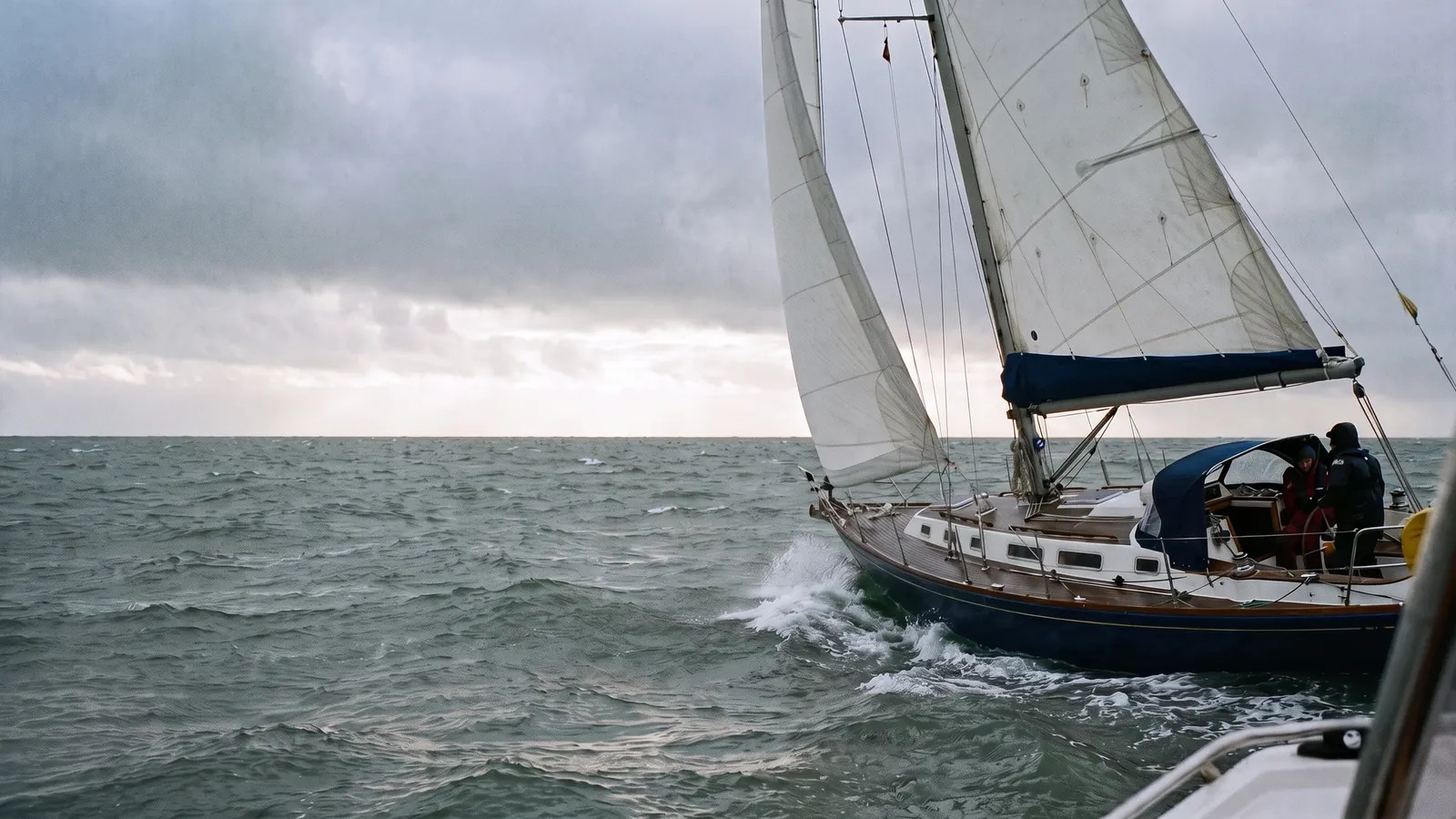
A boat's reefing plan lists the sails it carries at each apparent wind speed and angle, from full sail down to the deepest reef. The crew writes it before the passage from what they know of the boat, and keeps it at the helm. When the wind builds at 03:00, the person on watch reefs at the wind speed the plan shows and does not have to judge alone how much sail the boat can carry.
The plan is written in apparent wind, because that is the wind that loads the sails. Close-hauled, each reef goes in at a lower apparent wind speed than on a reach, and the headsail is rolled in with each reef in the mainsail. On a monohull the crew uses the plan together with the heel and the feel of the helm. A catamaran gives less warning as the wind builds, so on a catamaran the crew relies on the wind speeds in the plan.
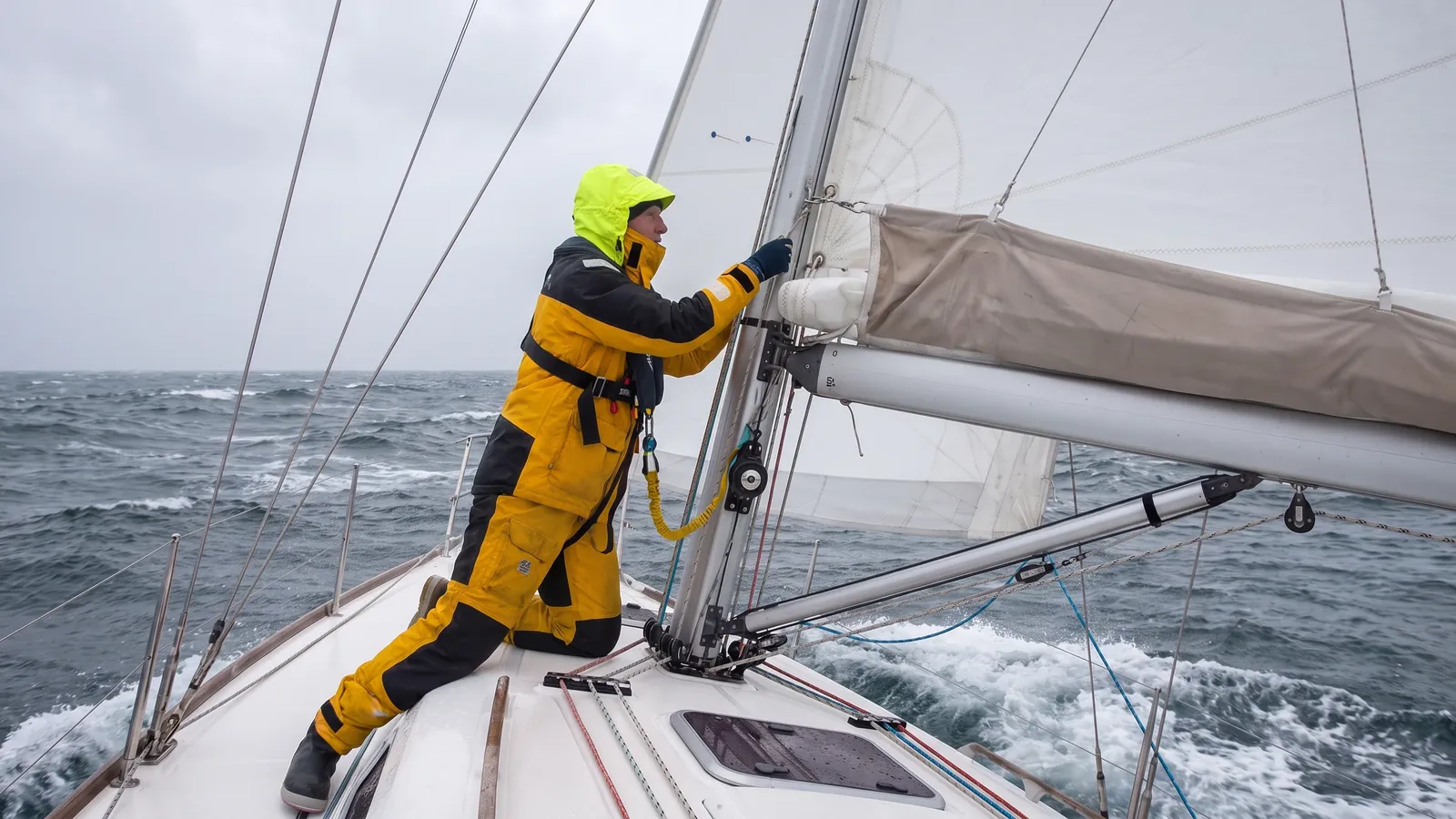
Write the plan in apparent wind speed and angle.
List the sail plans the boat uses, from full sail to the third reef, with the headsail size that goes with each mainsail reef. For each band of apparent wind angle, write the apparent wind speed at which each reef goes in, lower close-hauled than on a reach. Reef when the sustained apparent wind reaches the next row, and earlier for the gusts and for the night. After each passage, compare the plan with the log and adjust the thresholds where the boat was overpowered or slow.
Why the plan uses apparent wind.
The load on the sails comes from the apparent wind, the wind across the deck of the moving boat. The anemometer at the masthead measures the same wind, so the plan and the instrument the person on watch looks at use the same figure. Close-hauled, the apparent wind exceeds the true wind, and on a broad reach it is lighter, so in the same true wind the boat reaches each threshold sooner upwind.
The angle changes the load as well. Close-hauled, a large share of the force on the sails heels the boat and a smaller share drives it forward. With the apparent wind on the beam, more of the force pushes the boat along, so the same sail can be carried in a stronger apparent wind. You can start the downwind thresholds at the reaching values and lower them from the log, as in the example below. On a run the apparent wind is well below the true wind, and the boat has to come up into the full true wind to reef or to give way to another vessel.
The table is an example for one 40 ft cruising monohull. The figures are illustrative, and each boat's plan comes from its own sails and stability.
| Sail plan | Close-hauled, under 65° apparent | Reaching, 65° to 125° apparent | Downwind, over 125° apparent |
|---|---|---|---|
| Full Main + Jib 100% | Up to 15 kt | Up to 17 kt | Up to 17 kt |
| Reef 1 + Jib 66% | 15 to 20 kt | 17 to 22 kt | 17 to 22 kt |
| Reef 2 + Jib 50% | 20 to 25 kt | 22 to 27 kt | 22 to 27 kt |
| Reef 3 + Jib 33% | Above 25 kt | Above 27 kt | Above 27 kt |
A change of heading can move the boat into a different cell of the table while the forecast stays the same. Take 18 kt of true wind in flat water, with illustrative boat speeds. Close-hauled at 6 kt, the boat has about 23 kt of apparent wind at about 34°, which is reef 2. On a beam reach at 7 kt it has about 19 kt at about 70°, which is reef 1. On a broad reach, also at 7 kt, the apparent wind falls to about 12 kt at about 134° and the boat carries full sail.
Step down one reef at a time.
Each row of the plan is one sail plan, and each step down reduces the mainsail and the headsail together. Reducing the headsail at each step keeps the boat balanced. A reefed mainsail under a full headsail moves the center of effort forward, the weather helm eases, and the boat can develop lee helm as the bow falls away from the wind. A full mainsail with a small headsail gives heavy weather helm, and the rudder, held over to keep the course, slows the boat.
- Full main and full headsail. This covers the light and moderate wind speeds. Near the top of this range, ease the traveler and the mainsheet in the gusts to depower before the plan calls for a reef.
- Reef 1. The first reef in the mainsail, with the headsail rolled in to about two thirds of its size. It is the reef put in most often, so lead its lines where one person can handle them from the cockpit.
- Reef 2. The second reef and about half the headsail, for strong wind forward of the beam or a building sea.
- Reef 3. The third reef and about a third of the headsail, or a staysail on a boat that carries one. Above this row, consider a storm jib, a trysail, or heaving to.
- Light-air sails. At the other end of the plan, each light-air sail, such as a code zero, a gennaker, or a spinnaker, has its own range of apparent wind speed and angle. The bottom of the range is where the sail fills and holds its shape. The top is the wind speed at which the crew can still bring it down safely. Take these sails down before dark.
Reef early, for the gusts and before dark.
Put the reef in as soon as the sustained wind on the anemometer reaches the next row. At the bottom of the row the load on the sail, the reefing lines, and the winches is lower than when the boat is already overpowered, and the boat is still under control while the crew works. A reef that turns out to be early costs some speed and can be shaken out in a few minutes.
The plan is written for the sustained wind, and the gusts are the crew's decision. When the gusts on the anemometer or in the forecast reach the next row, consider reefing for them. Reef sooner with a small crew or under building convective cloud, because the gusts in a squall can be well above the forecast.
At night a reef takes longer, and fewer people are on deck to put it in. Choose the sail plan for the night one row deeper than the evening wind needs, so the person on watch can carry it until sunrise without calling the off-watch crew.
Using the plan on a monohull and a catamaran.
A monohull shows the crew when it is carrying too much sail. It heels further, the weather helm builds, and in the gusts it starts to round up. On a monohull, reef on those signs as well as on the anemometer, and use the plan to agree beforehand where each reef goes in.
A catamaran gives few of those signs. It stays close to level as the wind rises and the helm changes little, while the load on the mast and the rigging keeps growing. On a cruising catamaran, post the plan at the helm as a table of apparent wind speeds and angles, and reef at the wind speeds on it, for the gusts as well as the sustained wind. A catamaran also accelerates more in a gust, which raises the apparent wind upwind and lowers it downwind.
| Monohull | Catamaran | |
|---|---|---|
| Sign of too much sail | Heel, building weather helm, and rounding up in the gusts | Little change in heel or helm while the load in the rigging rises |
| How the crew uses the plan | With the heel and how the helm feels | By the anemometer, from a table posted at the helm |
| In a gust | Heeling eases part of the load on the sails | The sails and the rigging take the full gust, so reef for it |
Adjusting the plan from the log.
Test the plan on passage. Every hour, or at each change of watch, log the wind speed and angle on the instruments, the sail plan, the boat's speed, the heel, and how the boat steered. Mark the hours when the boat carried too much sail or too little. After the passage, change the thresholds to match what the log shows.
The figures in this example are illustrative. A crew sails a 40 ft monohull on a 300 nm passage with the plan in the table above.
- Close-hauled, 14 kt apparent at about 35°, full sail. In the gusts the boat heels to about 25°, the weather helm is heavy, and the autopilot lets it round up twice. The crew moves the first reef in the close-hauled column down from 15 kt to 13 kt.
- Beam reach, 21 kt apparent at about 90°, reef 1. The boat sails at about 7 kt with a light helm and an easy motion. The reaching column stays as it is.
- Broad reach, 20 kt apparent at about 140°, reef 1. At about 7.5 kt through the water, the true wind is about 26 kt. When a squall shows on the radar, the crew brings the boat up toward the wind to put in the second reef, and the apparent wind rises to about 29 kt while they work. The crew moves the second reef in the downwind column down from 22 kt to 19 kt, which at this speed on this heading is about 25 kt of true wind.
The log has the most hours in the reaching column. The close-hauled and downwind changes are based on a few hours each, so check those thresholds again on the next passage.
Sail plans in WeatherWindow.AI.
In WeatherWindow.AI you paint the plan as a grid, with apparent wind speed in the rows, apparent wind angle in the columns, and a sail plan from your own legend in each cell. For every hour of the projection, WeatherWindow.AI first checks any light-air sails you have set up, each with its own wind range and night setting, and then reads the grid at the projected sustained apparent wind angle and speed. The sail plan for that hour appears in the hourly table of the Passage Report, the Route Legs, the Passage Map, and the Sail plan ribbon in Departure Planning, with the apparent gust for the hour shown beside it. Comparing each hour's gust with the grid, and deciding whether to reef for it, is left to the crew.
Reefing plan questions, answered.
What is a reefing plan?
A reefing plan lists the sail plans a boat carries as the wind builds, and the apparent wind speed for each change to the next one. A typical plan steps from full sail through three reefs in the mainsail and rolls in the headsail at each step. With a column for each band of wind angle, the reefs come in at lower wind speeds when sailing to windward than when reaching.
Should a reefing plan use true wind or apparent wind?
Apparent wind. The sails work in the wind over the deck of the boat as it moves, and the anemometer at the masthead reads that wind. Sailing downwind, the apparent wind can be several knots below the true wind. Set the downwind thresholds low enough to allow for the stronger wind the boat feels when it comes up toward the wind.
Why do sailors reef earlier upwind?
For a given true wind, the apparent wind is stronger when the boat sails toward the wind, and with the wind forward of the beam a larger part of the sail force heels the boat. In 18 kt of true wind, a cruising boat close-hauled can have about 23 kt over the deck, while on a broad reach it has about 12 kt.
How is reefing different on a catamaran?
A catamaran does not heel to warn the crew that it is overpowered, and the feel of its helm barely changes as the rigging takes more load. On a catamaran, reef by the numbers from the plan posted at the helm, and consider reefing for the forecast gusts as well. On a monohull, the crew can judge from the heel and the weather helm as well as the anemometer.
Should I reef for the gusts or the average wind?
Base the plan on the sustained apparent wind and treat the gusts as a separate decision. If the gusts are reaching a deeper row of the plan, put the reef in for them, and do it sooner on a catamaran, at night, or with a small crew on deck. A squall can bring gusts well above any forecast figure, so keep a watch on the sky and the radar.
Does WeatherWindow.AI tell me when to reef?
No. For every hour, WeatherWindow.AI shows the sail plan from the grid you paint, read at the sustained apparent wind projected for that hour, with the apparent gust beside it. A cell left unpainted shows "No sail assigned". The sail plan is shown for planning only and does not change the projected speed, which comes from the boat's polars at the true wind, so the polars should describe the boat as it sails when reefed. The reefing plan is included in every WeatherWindow.AI plan.
Related articles
References and further reading.
- Yachting Monthly. Essential reefing tips for cruisers
- Cruising World. Master your catamaran's big main
- North Sails. Slab reefing systems and tips for reefing
- Practical Sailor. Reefing basics
- Yachting World. Bluewater sailing techniques part 3, coping with squalls
WeatherWindow.AI is a decision-support tool, not a professional weather routing service. It describes the forecast conditions on your passage and can draw weather routes, but it does not choose your route or decide whether you leave. Any route it draws is not checked against nautical charts. It does not replace official marine forecasts, a professional weather router, or your judgment as master.